Monero mining block odds and payout choices
Monero mining uses RandomX proof of work, and your share of network hashrate determines your approximate solo block odds. CPU performance determines how many hashes your machine can attempt. Solo miners receive rewards when they find a block the network accepts. Centralized pools and P2Pool distribute rewards among contributing miners under different rules. Electricity costs, valid submitted work and payout timing therefore matter alongside the number displayed by mining software.
last updatedRandomX ties mining speed to CPU resources
RandomX uses random program execution and memory-intensive operations to make general-purpose CPUs competitive in proof-of-work mining. Its design reduces the efficiency advantage specialized hardware could gain. GPUs can also perform RandomX work, although the algorithm favors CPUs. Hardware compatibility and competitive efficiency describe different things; an operational miner can still consume substantial electricity for its output.
Cache and memory limit useful thread counts
CPU cache capacity affects how many mining threads can work efficiently together. A useful sizing guideline is 2 MiB of L3 cache per mining thread. Memory bandwidth also constrains throughput, so adding threads does not necessarily increase hashrate. RandomX fast mode uses a shared dataset, while each thread needs working memory and cache resources. The lighter mode reduces memory requirements at the cost of speed. Available logical threads alone therefore give an incomplete picture of mining capacity. Other applications compete for the same resources during ordinary computer use.
Memory pages and sustained performance
Huge pages can improve RandomX performance when the operating system allocates them successfully. XMRig reports that allocation in its startup output. The feature changes mining efficiency without changing the network's proof-of-work rules. Sustained hashrate also reflects CPU settings and cooling. A brief benchmark cannot establish how consistently a machine will contribute work during prolonged operation.
How does hashrate determine solo block odds?
Under steady mining conditions, your approximate chance of finding the next network block equals your hashrate divided by total network hashrate. Both rates must describe RandomX work in matching units. Hashes per second, kilohashes per second and megahashes per second use different scales; comparing their displayed numbers directly produces an incorrect share.
The relationship can be written as
h/H, where
h
is your hashrate and
H
is the total network rate. Another estimate uses network difficulty
D: with sustained hashrate
h, the approximate expected solo waiting time is
D/h
seconds. This calculation assumes stable difficulty and valid work on the current chain. It describes a statistical mean across repeated attempts. Network hashrate estimates use block history or difficulty with an assumed interval. They cannot directly count every miner's present output, so different observation periods can produce different estimates.
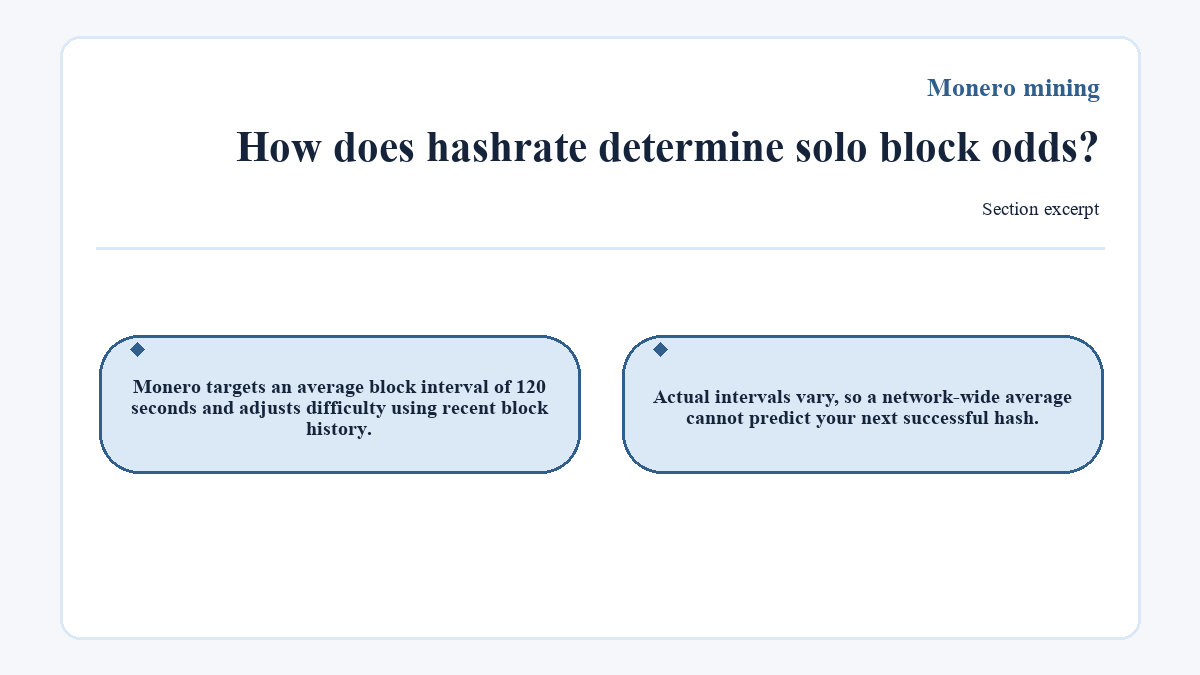
Monero targets an average block interval of 120 seconds and adjusts difficulty using recent block history. Actual intervals vary, so a network-wide average cannot predict your next successful hash.
A long wait does not accumulate progress toward a winning hash. At unchanged difficulty, the next valid hash attempt has the same success probability as an earlier attempt. Solo mining can therefore produce extended periods without income despite working correctly. Downtime and work on obsolete block templates further reduce the useful contribution behind a displayed hashrate.
Block rewards become spendable after maturity
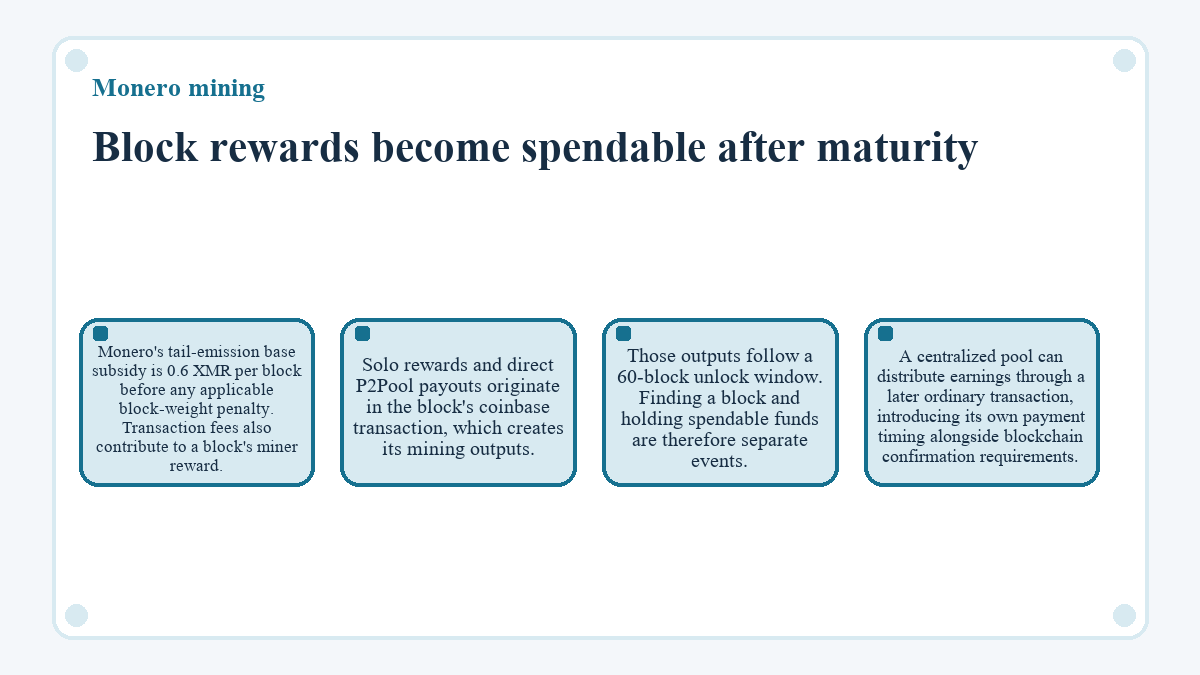
Monero's tail-emission base subsidy is 0.6 XMR per block before any applicable block-weight penalty. Transaction fees also contribute to a block's miner reward. Solo rewards and direct P2Pool payouts originate in the block's coinbase transaction, which creates its mining outputs. Those outputs follow a 60-block unlock window. Finding a block and holding spendable funds are therefore separate events. A centralized pool can distribute earnings through a later ordinary transaction, introducing its own payment timing alongside blockchain confirmation requirements.
What does a pool share actually prove?
A valid pool share proves the miner produced work meeting the pool's assigned difficulty target, which can be easier than Monero's network target. Shares allow accounting between less frequent network blocks. A server accepting a share records an accounting event under its rules; it does not establish a new Monero block or a spendable payment.
Share accounting and reward allocation
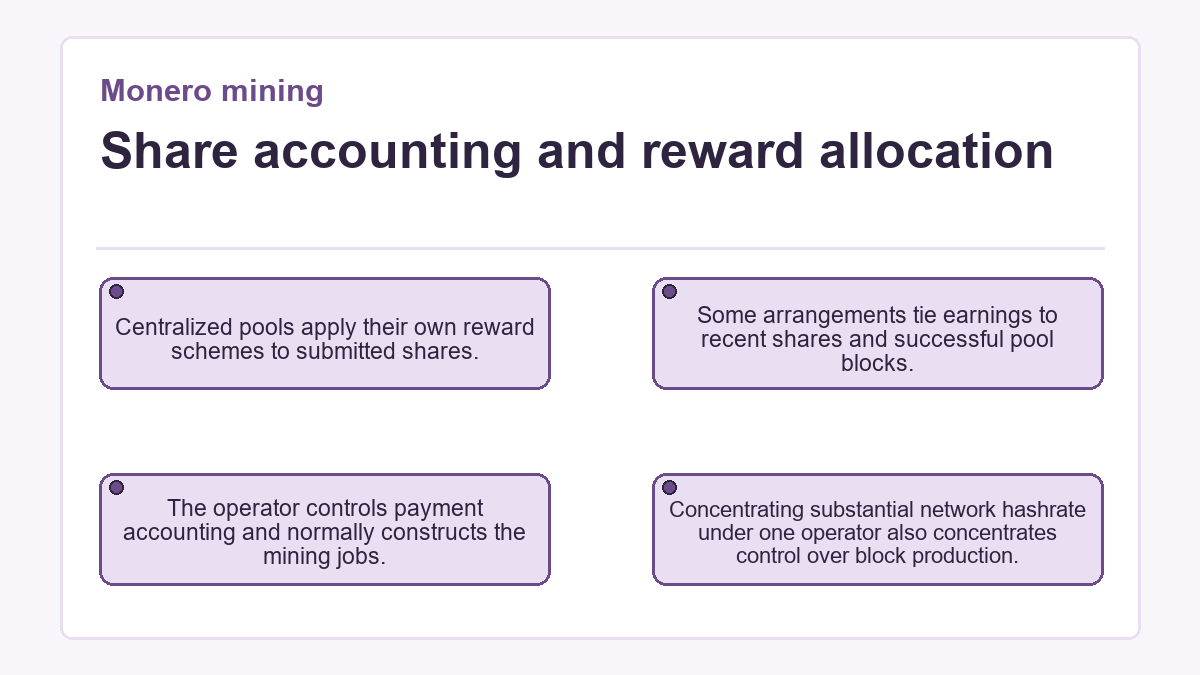
Centralized pools apply their own reward schemes to submitted shares. Some arrangements tie earnings to recent shares and successful pool blocks. The operator controls payment accounting and normally constructs the mining jobs. Concentrating substantial network hashrate under one operator also concentrates control over block production.
P2Pool uses a separate sharechain
P2Pool records qualifying shares on a sidechain and distributes Monero block rewards directly to eligible mining addresses. Its pay-per-last-N-shares system, or PPLNS, uses a moving share window. A share can leave that window before the sidechain finds a Monero block. Conversely, a share can participate in more than one block payout while it remains eligible.
Shares the P2Pool Stratum server accepts from XMRig do not all qualify as P2Pool sidechain shares. The sidechain's eligible shares determine participation in its payouts. P2Pool also makes mining addresses public, creating records outside the privacy protections of ordinary Monero transfers. A separate mining wallet avoids publishing an address used for unrelated payments.
Mining routes require different software setups
The built-in solo miner runs inside monerod, while Monero GUI or CLI controls its operation. That route requires a synchronized daemon and a primary receiving address. XMRig can also solo mine through a daemon's RPC interface. RPC means remote procedure call; it provides block templates and accepts submitted solutions instead of supplying ordinary pool jobs.
Centralized pool mining requires a compatible miner and the operator's connection settings. It does not require your own Monero node. P2Pool additionally needs a synchronized Monero daemon and its own node software.
| Mining setup | Work destination | Reward basis | Required setup |
|---|---|---|---|
| Built-in solo miner | monerod | An individual accepted block | Synchronized daemon and primary address |
| XMRig solo | Daemon RPC | An individual accepted block | XMRig, synchronized daemon and primary address |
| Centralized pool | Operator's mining server | The pool's share accounting | Compatible miner, payout address and pool connection |
| P2Pool main | Main sidechain | Eligible PPLNS shares | Configured daemon and P2Pool on main |
| P2Pool mini | Mini sidechain | Eligible PPLNS shares | Configured daemon and P2Pool with --mini |
| P2Pool nano | Nano sidechain | Eligible PPLNS shares | Configured daemon and P2Pool with --nano |
| The work destination determines which mining target and reward rules apply to submitted hashes. | |||
Main, mini and nano maintain separate sharechains while mining the same Monero network. At a fixed personal hashrate, lower share difficulty shortens the expected wait for a sidechain share. Mini or nano can suit low-hashrate miners, but a sidechain with lower combined hashrate finds fewer Monero blocks on average. Workers connect to a P2Pool instance through Stratum, the protocol for receiving jobs and submitting work. Monero GUI also offers P2Pool integration; the CLI wallet's built-in mining command controls solo mining. Interface support therefore determines how these choices appear, even when the underlying mining method remains available through separate software.
When does higher hashrate improve mining returns?
Higher hashrate improves expected net returns when the value of additional expected XMR rewards exceeds the extra cost of producing that work. Electricity costs follow wall power, runtime and the local tariff. Hashrate per watt helps compare configurations, although it cannot establish profitability by itself. Whole-system power includes components beyond the CPU. Software donations and pool charges can also reduce the work or earnings attributable to your address. Frequent small P2Pool payouts can create many outputs, increasing the inputs and transaction weight needed when later spending accumulated rewards.
Revenue estimates need a reward basis, network difficulty and the amount of time mining remains active. Solo mining adds substantial uncertainty to the timing of actual receipts. Pooling changes that distribution and adds the selected payout rules. The break-even threshold moves with the XMR price and electricity tariff, even when the mining configuration stays unchanged.
Monero mining - your questions answered
-
Can P2Pool mining rewards go to a subaddress?
- P2Pool's command-line interface supports subaddress payouts when both the primary address and the subaddress are configured. Both addresses must belong to the same wallet and network, and your installed build must support --wallet and --subaddress. Supply the primary address through --wallet and its subaddress through --subaddress. The standard monerod solo-mining route still requires a primary address.
-
Is a pruned Monero node sufficient for P2Pool mining?
- A synchronized pruned monerod node can support P2Pool mining. Pruning reduces the historical blockchain data the node stores; it does not remove the requirement to finish synchronization. The daemon must also provide the RPC access and ZMQ notifications P2Pool needs. Storage requirements still grow as the blockchain grows.
-
Does XMRig solo mining include a developer donation?
- Standard XMRig binaries devote at least 1% of mining time to developer donations, including when configured for solo mining. The mechanism directs some work to a developer donation destination. It does not subtract that percentage from funds already in your wallet. A pool operator's fee, when applicable, is a separate charge.
-
Why does XMRig display a huge-page allocation warning?
- A huge-page allocation warning means XMRig could not obtain some or all of the requested large memory pages. Operating-system permissions and available memory affect allocation. Mining can continue with reduced performance when this optimization is unavailable. The warning concerns memory setup; it does not itself establish an incorrect payout address or rejected work.
-
How can several computers mine through one P2Pool node?
- Multiple mining workers can submit work to the Stratum server of one reachable P2Pool instance. Each worker does not need its own blockchain copy. The payout address belongs to the P2Pool configuration, and an address entered in a connecting XMRig worker does not override it. The shared instance still needs access to a synchronized Monero daemon.
-
Must I reveal a recovery seed or private view key to receive mining rewards?
- Mining rewards do not require giving a miner or pool your recovery seed or private view key. A receiving address identifies the payout destination. The wallet retains the secrets it needs to recognize and spend outputs. Disclosing a view key exposes wallet information, while disclosing a recovery seed can expose spending authority.
-
Will a centralized pool send a balance below its payout threshold?
- A centralized pool enforcing a minimum payout can hold an unpaid balance until it reaches that threshold. The threshold belongs to the provider's payout policy rather than Monero's coinbase maturity rules. Applicable fees and payment schedules also affect release. A balance on a pool dashboard records operator accounting; it is not yet a spendable output in your wallet.
-
Are ordinary browser scripts suitable for efficient Monero mining?
- Ordinary browser scripts are unsuitable for efficient RandomX mining because the algorithm needs substantial memory and control over floating-point rounding, while standard JavaScript and WebAssembly execution lacks the directed rounding behavior RandomX needs to produce correct hashes.